
A CONVERSATION WITH MIGUEL EEK
THE ARCHIVE AS BRIDGE
Reframing archive footage to build a portrait
by Emanuele Vernillo
Origins and Production
In interviews about the film, you share that the project started around 12 years ago, when you decided to spend some time in Cape Verde and encountered the "figure" of Amílcar Cabral. You say that you started the research and the project by interviewing people who knew him or knew about him, but you discovered along the way that the form of the "interview" was not the right one for the film you wanted to make. Can you share with us how this process developed over the years? What were you really looking for?
Looking back, I realise that I wasn't really looking for Amílcar Cabral. I was looking for a way of understanding the world, and perhaps also myself.
The film was born during the economic crisis of 2012. At that moment my production company was struggling, television had stopped commissioning projects, and my partner and I decided to leave Spain for a while and move to Cape Verde. We lived a very simple life there. We walked a lot, cooked, read, wrote, spent long periods doing almost nothing. In retrospect, boredom became an essential creative condition. It slowed us down enough to become curious again. I didn't arrive in Cape Verde with the ambition of making a film about Cabral. It was much more modest than that. I simply became fascinated by this extraordinary figure who seemed strangely absent from European historical consciousness. Here was someone who had profoundly influenced anti-colonial struggles across Africa and yet remained almost invisible in Europe.
I wanted to know who he was. I started travelling between Guinea-Bissau, Cape Verde and Portugal, interviewing everyone I could find who had known him, fought with him, studied him or loved him. Little by little I accumulated more than forty interviews. At the time I thought I was building a film. Years later I realised I was actually building an archive.
The interviews were rich, but they all shared something: admiration. They described Cabral's intelligence, his charisma, his political vision. They helped me understand the historical figure, but they didn't allow me to experience him as a human being. I had information, but I didn't yet have cinema.That was probably the first major lesson of the project: curiosity can begin a film, but curiosity alone cannot sustain it. At some point you have to stop collecting answers and start asking different questions.
I must confess that I love your film; one can easily put it in the category of "Biopics", but it has such a brilliant way of bringing together a wide variety of formal choices in a very original way: poems, personal letters, pieces of diaries, public archives, re-enactment and contemporary analogue footage. You and your team did an amazing job. It might be a long answer, but can you tell us how you arrived at that?
Was that something you had already arrived at during the development and writing process, done with Alba Lombardia, or was that something you discovered later?
The honest answer is that I didn't design that structure from the beginning. It emerged because every previous version of the film failed. The first versions were much closer to a traditional historical documentary. They relied heavily on interviews and archival footage. They explained who Cabral was, what he did, why he mattered. Everything was perfectly logical. And yet something essential was missing. I realised that I admired Cabral, but I couldn't feel him.
The turning point came when I discovered his personal correspondence—especially the letters he wrote to his two wives—and his poems. Suddenly another person appeared. Not the revolutionary icon, but a man full of contradictions, doubts, tenderness, loneliness and desire. Those writings completely transformed my relationship with him. Until then I had been trying to explain Cabral. After reading those letters I became interested in something much more fragile: allowing myself to be challenged by him. From that moment on, the whole architecture of the film had to change.
The interviews became research. The archive was no longer simply illustrating history but entering into dialogue with intimate writings. The analogue images became less about reconstructing the past and more about expressing memory, absence and emotional proximity. Looking back, I think every formal decision came from the same question: not "How do we explain this man?" but "How do we create the conditions for the audience to encounter him?" That is a different kind of filmmaking.
Was it difficult to produce such a film?
It was probably the most difficult project I have ever worked on. Not only because it lasted more than ten years, but because the film kept changing its identity. In a way, we were constantly asking our producers and financiers to trust a film that we ourselves didn't fully understand yet. Looking back, I think the hardest part wasn't actually financing the film. It was protecting it from becoming a simpler film. There were many moments when we could have finished earlier by making a more conventional historical documentary. It probably would have been easier to explain, easier to finance and perhaps easier to distribute. But I increasingly felt that the complexity wasn't a problem to solve—it was the very subject of the film.
That required patience, trust and an extraordinary team of collaborators willing to embrace uncertainty.
I've also learned something important about authorship through this process. We often imagine the director as someone who knows where they're going. My experience was almost the opposite.
The film became possible because I surrounded myself with people who knew things I didn't know. Jacques Bidou challenged my sense of responsibility. Alba Lombardia helped me think about positionality and colonial perspectives. Federico Delpero transformed the editing into a space of thinking rather than simply assembling images. João Pedro embraced fragility instead of visual perfection. Elsa gave the film its emotional acoustic landscape. The older I get, the less I believe in the myth of the solitary auteur. I believe in conversations.
I believe films become better when they are made by people who gently but persistently challenge each other's certainties.
Was it a long archival research process? Can you also share something about that?
The archival research was probably the longest and loneliest part of the entire project.
For years, I did most of it on my own: contacting archives, travelling, writing emails and trying to understand what existed and where. The research happened in parallel with the production. It wasn't a separate phase. There were two main stages. During the long development period, I found roughly half of the archival material that eventually appears in the film. Those discoveries constantly reshaped the writing.
Then, once we secured financing, everything accelerated. We finally had the resources to continue the research, negotiate rights and access collections that had been out of reach. That was also when Alba Lombardia joined the project. After so many years working alone, she brought an invaluable sense of clarity and structure. She helped transform a huge collection of documents into something that could become a film.
But the biggest challenge wasn't finding the archive. It was learning how to look at it.
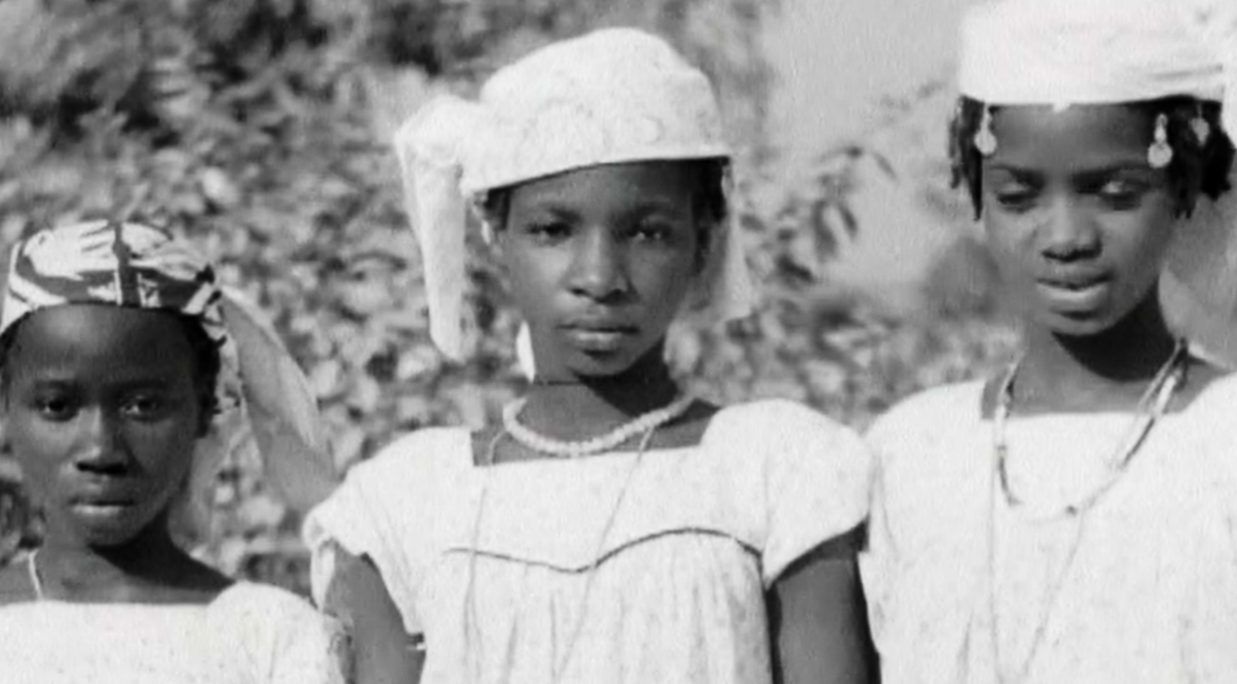
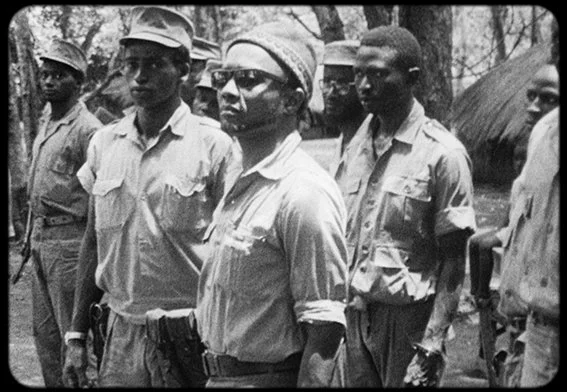
Many of the images were produced within colonial structures, so we kept asking ourselves: Can a colonial image become part of a decolonising film?I think it can—but it never stops reminding us where it comes from. We didn't use those images because they were innocent. We used them because, in many cases, they were the only images that existed. Learning to work with that contradiction became one of the central creative and ethical challenges of making Amílcar.
The Creative Process
How did you work on the footage you shot? How did you "write" it? Did it emerge later in the editing process, or was it already present in the development process?
The shooting didn't begin with a conventional script. It began with small notes and a willingness to embrace the uncertainty of the shoot.
As the editing progressed, I started identifying the gaps in the film—those places where the archive couldn't take us, where history had left no images, or where Cabral's inner life simply couldn't be expressed through documents or interviews.
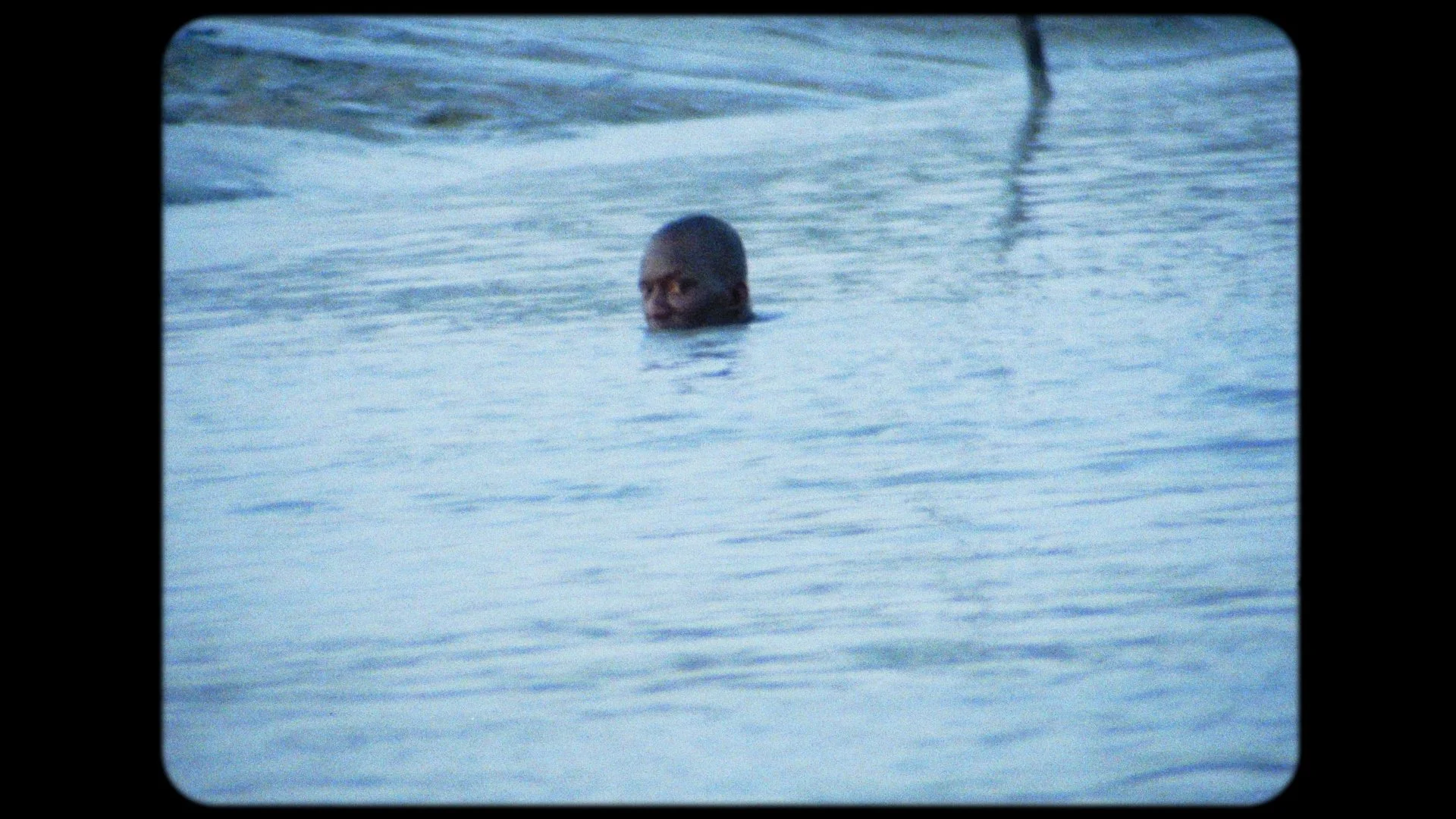
I travelled to Guinea-Bissau, Cape Verde and Portugal carrying those notes rather than a shot list. I wasn't trying to illustrate the story. I was looking for images that could evoke Cabral's subjectivity. How might he have looked at a landscape? At children? At the sea? At the idea of justice? At solitude? At fear? At the experience of travelling endlessly between countries and identities?
Those contemporary analogue images don't pretend to reconstruct the past. They create a space where the audience can imagine what the archive cannot show. In that sense, I think the footage was written through absence. Every image was trying to respond to something that was missing. Not factual information, but an emotional or poetic dimension that I felt was essential to understanding Cabral—not only as a political leader, but as a human being.
How did you do it technically? Which film stock did you use? Which film camera? Where did you have it developed?
We shot the contemporary footage on 16mm using both an Arriflex and a Bolex, mainly on Kodak colour stock. One of the reasons for choosing film was that we wanted those images to dialogue naturally with the archival footage, much of which came from Sweden, Cuba, France, Italy and Guinea-Bissau.
We weren't trying to imitate the archive, but to create a visual continuity between past and present.
Technically, it was far from an easy shoot. Both cameras were old mechanical cameras, and we probably spent almost as much time repairing them as we did filming. On top of that, working with film in West Africa meant dealing with customs delays, limited stock and the constant awareness that every metre of film mattered.
Those limitations completely shaped the way we worked. We couldn't afford to shoot endlessly. Every shot had to be carefully observed before pressing the trigger. In that sense, analogue wasn't simply an aesthetic choice; it became a discipline. It forced us to slow down, to be patient and to accept uncertainty.
Looking back, I think those constraints became part of the language of the film. The fragility of the process somehow echoed the fragility of memory itself.
The film tells the trajectory of a revolutionary man and covers historical events, but there is a continuous (wonderful) coming back to a poetic "level", to something that is constantly in relationship with our heart rather than our brain.
This is what makes yours, for me, a great film rather than, simply, a documentary. Emotions, art and poetry are constantly central elements of your work. Can you say something more about your intentions?
One of the very few certainties I had from the beginning was that I didn't want the film to operate primarily through reason. I wanted it to work emotionally.
There are already many books and historical essays that explain who Amílcar Cabral was. I wanted to explore the possibility of feeling close to someone across time.
That meant accepting that the film wouldn't explain everything. Certain historical debates, political complexities and even contradictions had to remain outside the cut. It wasn't because they weren't important, but because I wanted to remain faithful to a different kind of experience.
I wanted the audience to vibrate with the conflicts Cabral himself was going through, rather than simply understand them intellectually.
Discovering Cabral's poems and his writings as an agronomist was fundamental. They revealed someone who observed the world with extraordinary sensitivity. He looked at landscapes, plants and people with the same attention. That poetic and observational gaze gradually shaped not only the selection of texts, but also the way we filmed the contemporary images.
In the end, I wasn't interested in illustrating his ideas. I wanted the form of the film to echo the way he looked at the world.
How did you work with your editor? How did you both work to keep all these formal elements together?
My relationship with my editor, Federico Delpero, actually began on my previous film, Burden. By the time we started working on Amílcar, we had already developed a way of collaborating that is based much more on conversation than on editing itself.
We spent countless hours talking about the material—what we were seeing, what we weren't seeing, how certain sequences made us feel, and what the film seemed to be asking from us. Sometimes I would leave the editing room completely exhausted, not because we had edited all day, but because we had spent hours thinking together. Those conversations gradually built a shared intention.
For me, the editing room became the place where the film truly found its identity. The structure, the rhythm, the relationship between archive, letters, contemporary footage and silence… none of that was predetermined. It emerged through a long process of questioning almost every decision.
We worked together for more than two years, and I honestly think that the final form of the film is the result of that time. Not because we were searching for perfection, but because we were trying to remain faithful to what the film itself was asking us to become.
The older I get, the more I think editing is less about organising images than about learning to listen to them. And Federico has an extraordinary ability to listen before deciding.
I feel that the soundtrack and the sound design overall also contribute to underlining that emotional register of the film I was talking about: can you tell us more about the artistic relationship you had with the professionals who worked on the sound and the music?
Sound was one of the biggest creative challenges of the film. A large part of the archival material either had no synchronous sound, no soundtrack at all, or sound of such poor quality that it had to be almost entirely reconstructed. So we weren't simply editing sound—we were rebuilding an acoustic world that no longer existed.
That process actually began during the editing with Federico Delpero. Even before the final sound design, we spent a lot of time experimenting with the relationship between sounds, atmospheres and silence, trying to understand how each sequence wanted to breathe.
The final stage happened last summer in Portugal, where Elsa and I spent several weeks working together in a studio in the countryside. It was a beautiful process because we weren't only restoring sounds; we were sculpting them.
We worked on everything, from the texture and presence of Cabral's own voice to the sound of the wind, the sea, footsteps, or the resonance of an explosion. Every sound became part of the emotional language of the film.
The music was chosen much earlier, during the editing process. Federico and I selected the soundtrack together, drawing from his extraordinary personal music library rather than commissioning an original score. In the end, I think the sound does something similar to the contemporary analogue footage. It doesn't try to recreate reality exactly as it was. It tries to create an emotional space where the audience can inhabit the film.
Beauty, Freedom and Technology
There is a quote in the film from Amílcar Cabral, who says, more or less: "the search for beauty is desperate, but always fruitful". That sentence stays with me and it resonates when I think about your film, since this is what your film is constantly doing, searching for "beauty": are we human beings still in search of beauty nowadays?
I believe that human beings have a deep need to seek beauty. It's almost an anthropological impulse. The problem is not that we've stopped looking for beauty, but that we often look for it in the wrong places. We live in a time when beauty is increasingly confused with perfection, speed, spectacle, or whatever algorithms decide deserves our attention.
In that context, artificial intelligence presents a profound challenge. Not because it is inherently negative but because it can accelerate a certain dehumanisation of the way we create, look, and listen. If we begin to outsource our imagination, our creativity, or even our capacity to observe to systems that are designed to reproduce what is already probable or familiar, we risk losing what makes art deeply human: vulnerability, contradiction, intuition, imperfection, and lived experience.
Cinema, and documentary cinema in particular, asks us to do the opposite. It invites us to slow down, to pay attention, to listen carefully, and to embrace complexity. It reminds us that reality cannot be reduced to a formula or an algorithm. I think that is where a much deeper kind of beauty lies—not in perfection, but in the encounter with reality, even when that reality is fragile, uncomfortable, or ambiguous.
For me, making films is, in that sense, an act of resistance. It is a way of defending our ability to see with our own eyes, to listen with our own ears, and to develop our own understanding of the world. Beauty is not about flawless images; it is about the truth that an image can reveal.
Amílcar Cabral, apart from his controversial human and political aspects (he was accused many times of racism and violence), is in my opinion a truly contemporary figure, both in politics and in art: how important is it, for us as artists, to keep our freedom and our creative independence?
If freedom ever ceased to be a fundamental right, I think my motivation to make films would probably disappear. For me, cinema only makes sense as an act of freedom—freedom to question, to observe, to doubt, and to imagine other ways of seeing the world.
At the same time, we have to acknowledge that freedom is not equally distributed. It is an unequal right, one that millions of people still have to fight for every day. That is why I believe it has to be constantly defended and reclaimed.
I try to do that through every aspect of my work. Not only through the films I direct, but also through the films I produce, the films we program at MajorDocs Film Festival, and the projects I mentor and select when working with emerging filmmakers. In all these spaces, I encourage people to protect their creative freedom and to resist the pressures that push us towards conformity.
For me, the greatest danger today is uniformity. We are surrounded by forces that encourage us to think alike, create alike, and tell stories in predictable ways. What I hope never disappears is the wild, untamed part of every filmmaker's gaze—the part that cannot be standardised, optimised, or replicated. That is where genuine cinema begins, and that is what we have to protect.
I close the interview by sharing a question I also asked Maciej Drygas, who was part of the last edition of ANALOGICA with his masterpiece, TRAINS: nowadays there is an increasing interest in the use of archive and found footage, and also in an independent and "domestic" way of using film material, such as Super 8, 16mm, or VHS. ANALOGICA is an example of that.
The mainstream narrative does not seem aware of that and, for example, it is underlining the increasing importance of generative artificial intelligence. At the same time, it seems to me that the younger generations have a growing interest in the use of analogue devices too.
What do you think about it? Can we still cultivate a "hope" for a critical, honest and fair use of all technological innovations, with respect for the history of cinema and art in general?
I'm not sure if this is a battle between analogue and digital, or between film and artificial intelligence. Every technological innovation has changed cinema, and every generation has had to redefine its relationship with images. The real question is not which tools we use, but what kind of gaze those tools encourage.What I find encouraging is that many young filmmakers are returning to analogue formats, found footage, and archival material—not simply because they are nostalgic, but because these materials carry time, memory, materiality, and a physical relationship with reality. They remind us that every image has a history, a context, and an author.
Artificial intelligence, on the other hand, opens extraordinary possibilities, but it also forces us to ask difficult questions about authorship, truth, and responsibility. Technology itself is never ethical or unethical; what matters is how we choose to use it, and whether it expands or diminishes our capacity to think, to imagine, and to empathise. So yes, I remain hopeful. But hope is not something that happens by itself. It has to be cultivated through education, through artistic practice, and through institutions that continue to defend diverse voices and cinematic heritage. Festivals like ANALOGICA, archives, film schools, and independent filmmakers all have an essential role to play.
In the end, I don't believe audiences are looking for perfect images. I think they are looking for meaningful ones. Whether an image is shot on Super 8, 16mm, a smartphone, or created with the help of artificial intelligence is ultimately secondary. What matters is whether it reveals something true about the world and about ourselves. If cinema can continue to do that, then I believe there is every reason to be hopeful.
Miguel Eek (Madrid, 1982) is a documentary filmmaker and producer.
He graduated from ESCAC (Escola Superior de Cinema i Audiovisuals de Catalunya) and completed a residency at Arcada University of Applied Sciences in Helsinki.
His films focus on social margins, collective memory and formal experimentation, moving between close observation and essayistic cinema. Often the result of long processes of research and dialogue with their protagonists, his works develop a poetics that oscillates between testimony and political reflection, addressing themes such as identity, gender, historical memory, and cinema as a space for community encounter.
His films have been selected and awarded at more than fifty festivals worldwide. City of the Dead (2019) screened at some thirty festivals, including Fipadoc and Seminci, and received the City of Palma Award. The same year, his feature The First Woman (2020) had its world premiere in the First Appearance section of IDFA and went on to screen at more than twenty international festivals. His most recent film, Burden (2024), co-produced by TV3 and Filmin, premiered at Fidba. Sinc
Emanuele Vernillo Tutor at ZeLIG’s three-year program since 2010 and Responsible of the same program since September 2025. He is also Vice-President of the cooperative.
He has worked in both documentary and feature film productions, and has collaborated intensely with director Pietro Marcello. He engineered the live sound for the film “La Bocca del Lupo”; was assistant director for “'Il Silenzio di Pelesjan”; and was in charge of organisation for “'Bella e Perduta” – all award-winning films at top international film festivals, including Venice, Berlin, Toronto and Torino.
He organises independent film series since many years, writes poetry and holds a B.A. and a Master in Anthropology of Development. He graduated from ZeLIG in 2007.
© August 2026 / Emanuele Vernillo / Analogica